



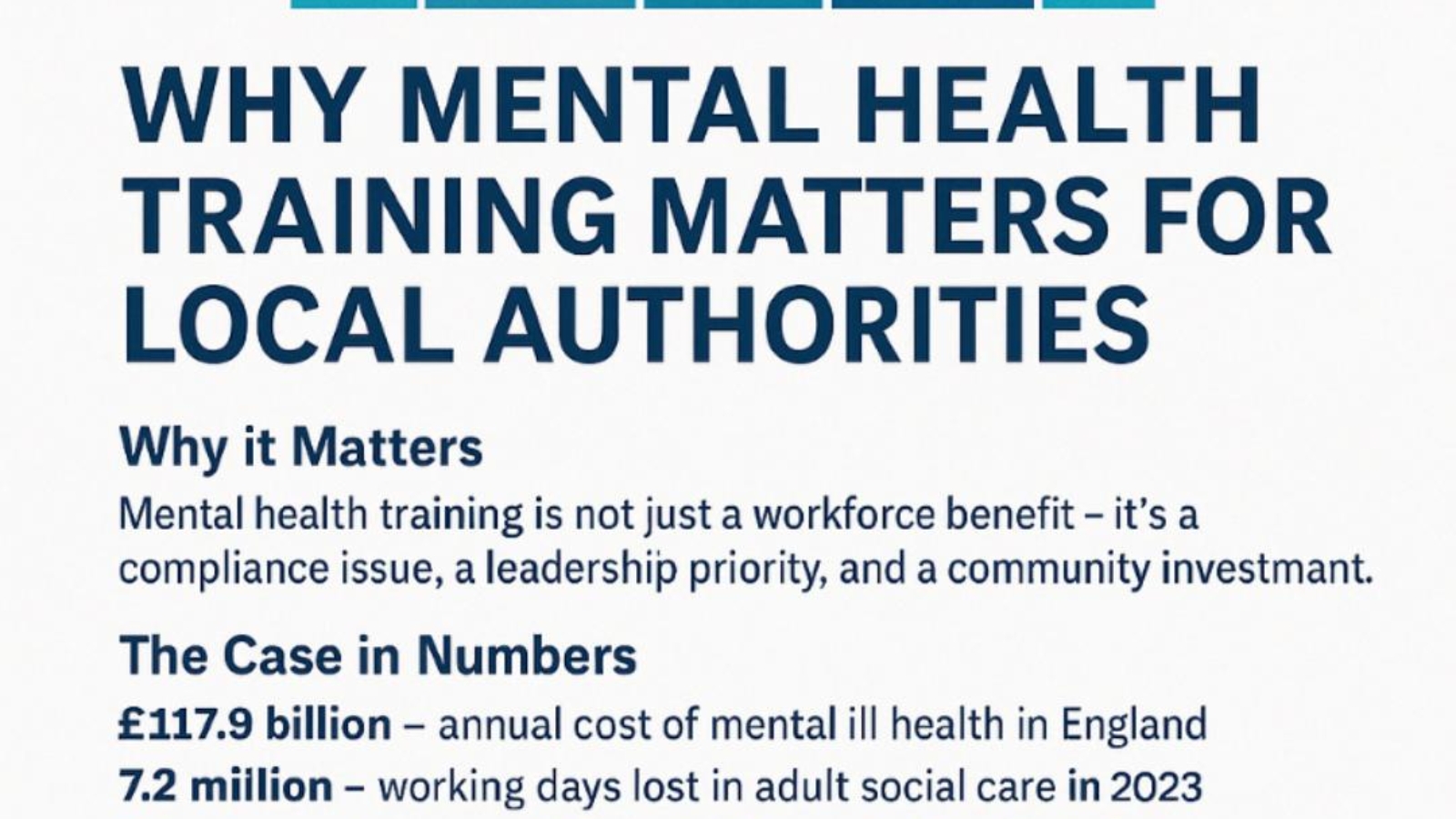
Mental health is no longer a “nice to have” on council agendas. It is a statutory responsibility, a workforce imperative, and a powerful lever for better outcomes across communities and local economies. Targeted, high-quality training is how local authorities (LAs) turn those responsibilities into day-to-day practice—on the front desk, in commissioning teams, in care settings, and in the Leader’s office.
The case in numbers (and why this is a leadership issue)
- Work-related ill health remains high in Great Britain: 1.7 million people reported work-related ill health in 2023/24; around 776,000 of these cases related to stress, depression or anxiety. That translated into 33.7 million working days lost.
- The broader economic cost of mental health problems to the UK is estimated at £117.9 billion a year, largely due to lost productivity and informal care.
- In adult social care alone, Skills for Care estimates ~7.2 million days were lost to sickness in 2023/24—pressure that ripples into cost, continuity and quality.
For LAs, these aren’t abstract figures. They affect service resilience, statutory performance, and place-based outcomes—from safeguarding and homelessness to economic inclusion.
The statutory and strategic drivers behind training
Health & Safety law (stress as a workplace risk). Employers—including councils—have a legal duty to assess and control risks to employees’ health, including work-related stress. HSE is explicit: conduct a stress risk assessment and act on it (using the Management Standards where appropriate). Training equips managers and teams to meet that duty.
NICE guidance (NG212). NICE’s Mental wellbeing at work guideline calls on local and regional authorities to lead, integrate mental wellbeing into local strategies, support employers (especially SMEs), and use contracting/ethical procurement to encourage good practice. Training—particularly for line managers and supervisors—is a core recommendation.
Integrated Care Systems (ICSs). The Health and Care Act 2022 put LAs at the table with NHS partners through Integrated Care Partnerships (ICPs). ICPs must produce an integrated care strategy; CQC now assesses how systems (including LAs) work collectively to improve outcomes. Workforce capability—mental health literacy, prevention and early help—is essential to delivery.
Suicide prevention duty to lead locally. England’s 2023–2028 Suicide Prevention Strategy expects every area to maintain and deliver a multi-agency suicide prevention plan; public health teams in LAs coordinate much of this work, where training (e.g., suicide awareness, safe conversations, post-vention) is a key enabler.
Social value and commissioning. Under the Public Services (Social Value) Act 2012, public bodies consider social, economic and environmental benefits in procurement—opening the door to require workforce mental-health outcomes (e.g., line-manager training, stress risk management) from providers. Central government’s Social Value Model (PPN 06/20) shows how to explicitly evaluate such outcomes; many councils adapt similar approaches.
What “mental health training” should mean for councils (it’s prevention first)
Effective programmes go beyond one-off awareness days. They build capability to prevent harm, spot issues early, and respond well—across the whole council and its supply chain. Four pillars:
- Primary prevention at work (managers and teams). Train managers to design healthy work (demands, control, support, relationships, role and change), hold confident wellbeing conversations, and fulfil stress-risk duties. This aligns with HSE’s Management Standards and NICE’s focus on preventive, manager-centred interventions.
- Public-facing conversations at scale (MECC). Adopting Making Every Contact Count (MECC) gives all frontline staff brief-intervention skills to promote wellbeing and signpost support, including for mental health—across customer service, housing, libraries, registrars and more. MECC is endorsed nationally and supported by free e-learning and implementation guides.
- Suicide awareness and crisis pathways. Targeted training (from basic awareness to advanced modules for first responders, housing officers and social care teams) strengthens local suicide prevention plans and multi-agency practice.
- Trauma-informed and equitable practice. Equip staff to recognise trauma and reduce stigma—particularly for groups at higher risk of poor outcomes—to meet the Public Sector Equality Duty and improve access and experience. (NICE and WHO reinforce organisation-wide, skills-based approaches.)
The business case (and what finance directors want to see)
Deloitte’s UK analysis shows employers see an average ROI of about £5 for every £1 invested in mental-health support—especially for organisation-wide culture change and proactive training. That ROI comes through lower absence, improved retention and reduced presenteeism.
Layer that onto the local context—HSE’s ongoing high levels of stress-related ill health and Skills for Care’s sickness burden in social care—and the fiscal case becomes hard to ignore. Preventive training is one of the few levers that reduces demand (by catching issues early) and unit cost (by stabilising teams) at the same time.
Who needs what (a whole-council model)
- Elected members & senior leaders: Strategic oversight of workforce wellbeing; governance for stress risk management; role-modelling psychologically safe leadership; aligning with ICS/ICP strategies.
- Line managers & supervisors (all services): Primary-prevention training, conducting team stress risk assessments, reasonable adjustments, return-to-work support.
- Frontline/public-facing staff: MECC-style brief conversations; stigma reduction; local pathways and signposting.
- Commissioners & procurement: Embedding mental-health requirements and measures in contracts using Social Value Act principles; monitoring provider workforce outcomes.
- Adult social care, housing & community safety: Enhanced modules (suicide awareness, trauma-informed practice, risk escalation).
A practical, tiered curriculum you can commission
Tier 1 – Foundations (all employees, 90–120 minutes, e-learning + micro-workshops).
Mental health literacy, stigma, “how to have a supportive conversation,” signposting, MECC basics.
Tier 2 – Managers & supervisors (half-day + action learning).
Designing good work using HSE Management Standards; team stress risk assessment; reasonable adjustments; psychologically safe meetings; managing attendance and return-to-work.
Tier 3 – Role-specific modules (1 day).
- Suicide awareness & post-vention (housing, ASC, public protection).
- Trauma-informed communication (ASC, children & families, libraries).
- Crisis triage and local pathways (with ICS partners).
Tier 4 – Leaders (Cabinet/CLT, 2–3 hours).
Governance for wellbeing; KPIs and dashboards; aligning the LA People Strategy with NICE NG212 and ICP priorities; commissioning levers and social value.
Refresh & sustain. Annual refreshers (30–45 minutes), reflective supervision for high-exposure roles, and peer champions to keep momentum.
Commissioning levers you can use this year
- Write it into specifications. For people-intensive contracts, require providers to:
- Train line managers in stress prevention and supportive conversations;
- Conduct annual team stress risk assessments and action plans;
- Report on mental-health-related absence and retention as part of contract KPIs;
- Participate in place-wide suicide prevention training (where relevant).
Anchor these to the Social Value Act and, where appropriate, adapt the central Social Value Model outcomes for local use.
- Use ICP collaboration. Commission joint modules across councils, NHS providers and the VCSE to build shared language and pathways—improving consistency and value for money.
- Open access to MECC e-learning for council staff, volunteers and key contractors; track completions and local referral volumes.
What to measure (and report to Cabinet)
- Inputs/coverage: % of staff by tier trained; % of managers completing stress risk assessments.
- Workforce outcomes: sickness absence (mental-health-related), turnover in high-exposure services, staff survey indicators for workload, autonomy and support.
- Community outcomes (selected): self-harm presentations signposted, timely referrals to local services, uptake of community support (via MECC signposting); progress against local suicide prevention plan milestones.
- Value: ROI proxy using Deloitte benchmarks (e.g., £5:£1) adapted to local absence/turnover data.
Common pitfalls (and how to avoid them)
- Tick-box training. One-off awareness doesn’t shift outcomes. Combine training with stress-risk processes, supervision and leadership behaviours, as per HSE and NICE guidance.
- Over-reliance on individual resilience. Focus first on work design and organisational factors; resilience offers are adjuncts, not substitutes.
- Poor alignment with ICS partners. Use ICPs to co-commission and standardise, especially for suicide prevention and crisis pathways.
A 12-month starter roadmap
- 0–90 days: Approve a corporate position statement on mental wellbeing at work; baseline stress risks in priority services; launch Tier-1 e-learning and a manager “essentials” sprint.
- 90–180 days: Roll out Tier-2 manager training; embed MECC across public-facing teams; initiate suicide prevention modules with ICP partners.
- 180–365 days: Bake requirements into new procurements under Social Value; extend Tier-3 modules; implement dashboards and Cabinet reporting; publish lessons learned with partners.
Bottom line
Mental health training is not a peripheral staff benefit. For local authorities it is a compliance issue, a workforce strategy, and a population-health intervention—all at once. Done well, it prevents harm, supports staff, improves services, strengthens partnerships, and pays for itself. The tools, standards and evidence already exist; the task now is disciplined implementation and visible leadership.
References
- Cabinet Office (2020) Procurement Policy Note (PPN 06/20): Taking account of social value in the award of central government contracts. London: Cabinet Office. Available at: https://www.gov.uk/government/publications/procurement-policy-note-0620-taking-account-of-social-value-in-the-award-of-central-government-contracts (Accessed: 21 August 2025).
- Centre for Mental Health & Mental Health Foundation (2022) The economic and social cost of mental ill health in England. London: Centre for Mental Health. Available at: https://www.mentalhealth.org.uk/explore-mental-health/statistics/the-economic-and-social-cost-of-mental-ill-health-in-england (Accessed: 21 August 2025).
- Deloitte (2020) Mental health and employers: Refreshing the case for investment. London: Deloitte UK. Available at: https://www2.deloitte.com/uk/en/pages/consulting/articles/mental-health-and-employers-refreshing-the-case-for-investment.html (Accessed: 21 August 2025).
- Department of Health and Social Care (2023) Suicide prevention in England: 5-year cross-sector strategy (2023 to 2028). London: DHSC. Available at: https://www.gov.uk/government/publications/suicide-prevention-strategy-for-england-2023-to-2028 (Accessed: 21 August 2025).
- Health and Safety Executive (2023) Work-related stress, anxiety or depression statistics in Great Britain, 2023. London: HSE. Available at: https://www.hse.gov.uk/statistics/causdis/stress.pdf (Accessed: 21 August 2025).
- Health and Safety Executive (2024) Stress at work – Employers’ responsibilities. London: HSE. Available at: https://www.hse.gov.uk/stress/employer.htm (Accessed: 21 August 2025).
- NHS England (2024) Making Every Contact Count (MECC). NHS England. Available at: https://www.england.nhs.uk/mecc/ (Accessed: 21 August 2025).
- NICE (2022) Mental wellbeing at work (NG212). London: National Institute for Health and Care Excellence. Available at: https://www.nice.org.uk/guidance/ng212 (Accessed: 21 August 2025).
- Skills for Care (2023) The state of the adult social care sector and workforce in England 2023. Leeds: Skills for Care. Available at: https://www.skillsforcare.org.uk/adult-social-care-workforce-data/Workforce-intelligence/publications/national-information/The-state-of-the-adult-social-care-sector-and-workforce-in-England.aspx (Accessed: 21 August 2025).
- UK Government (2022) Health and Care Act 2022. London: The Stationery Office. Available at: https://www.legislation.gov.uk/ukpga/2022/31/contents/enacted (Accessed: 21 August 2025).
Report-Style with Hyperlinks
- HSE – Work-related stress, anxiety or depression statistics in Great Britain, 2023
- HSE – Stress at work: Employers’ responsibilities
- NICE – Mental wellbeing at work (NG212)
- DHSC – Suicide prevention strategy for England 2023–2028
- Health and Care Act 2022
- Centre for Mental Health – The economic and social cost of mental ill health in England
- Deloitte UK – Mental health and employers: Refreshing the case for investment
- Skills for Care – The state of the adult social care sector and workforce in England 2023
- Cabinet Office – Social Value Act and PPN 06/20
- NHS England – Making Every Contact Count (MECC)
Add a Comment